
By AryaTech Editorial Team
19 October 2026
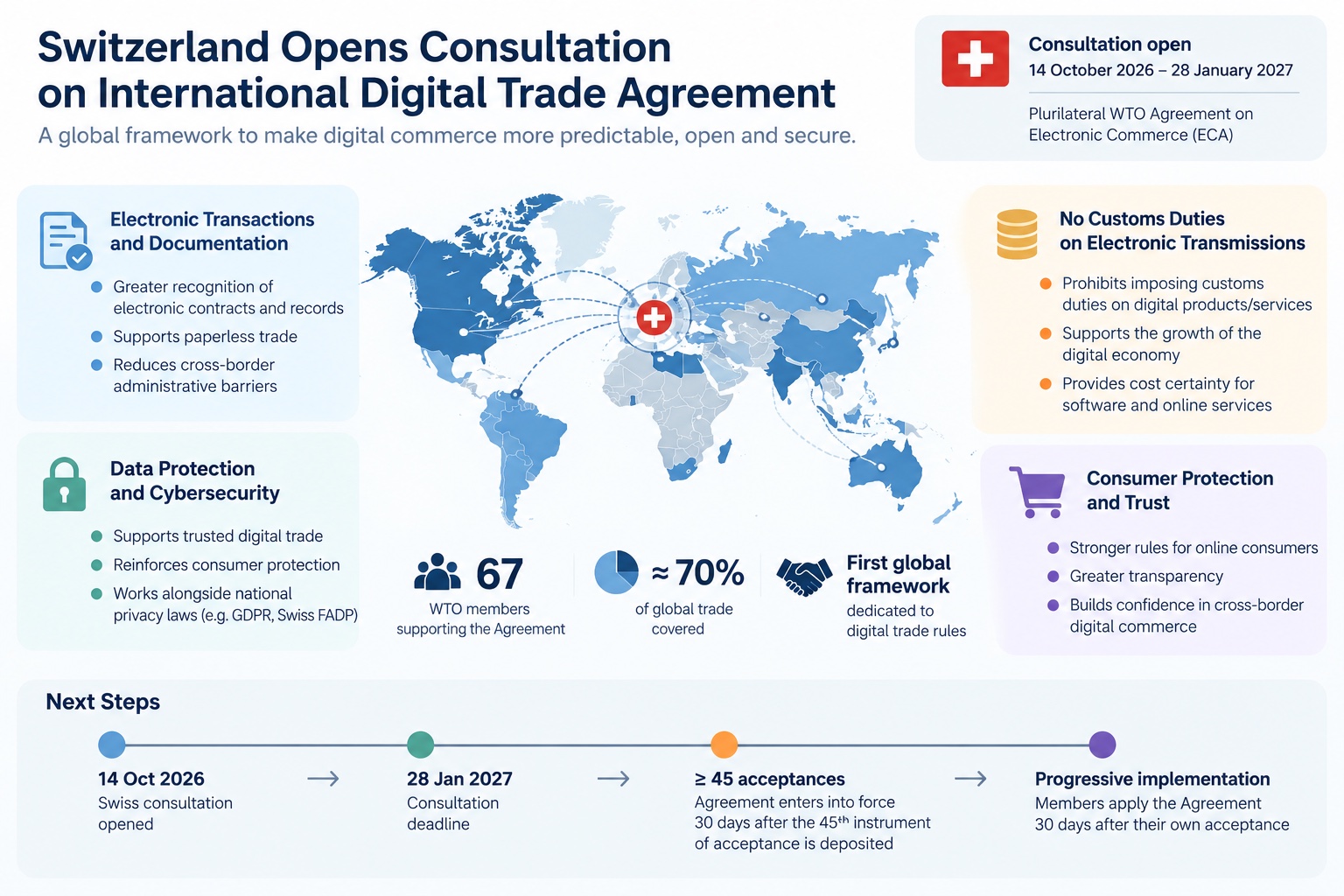
Switzerland has taken an important step toward joining the first broad international framework designed specifically to establish common rules for digital trade.
On 14 October 2026, the Federal Council opened consultation on the plurilateral Agreement on Electronic Commerce (E-Commerce Agreement, or ECA). The consultation will remain open until 28 January 2027.
The Agreement has been developed within the framework of the World Trade Organization and is supported by 67 WTO members representing approximately 70% of global trade. Its objective is straightforward but potentially significant: to make cross-border digital commerce more predictable by creating a common baseline for electronic transactions, digital documentation, consumer protection, data protection and cybersecurity.
For Swiss technology companies, the relevance extends considerably beyond traditional e-commerce.
The Agreement potentially affects the environment in which SaaS providers, fintech businesses, digital marketplaces, cloud-service companies, online professional services and other technology businesses operate across borders.
It does not eliminate national regulation. Nor does it create a single global digital law.
What it attempts to do is reduce some of the legal and administrative friction that still exists when commercial transactions move from paper and physical delivery into digital infrastructure.
From national digital rules to an international baseline
Cross-border commerce has become increasingly digital, but the legal environment in which it operates remains fragmented.
A company may conclude a contract electronically in Switzerland, issue digital documentation to a client in another jurisdiction, provide the service through cloud infrastructure located elsewhere and receive payment through a completely different financial system.
The technology may treat this as one seamless transaction.
The law often does not.
Different jurisdictions can maintain different rules on electronic signatures, electronic records, consumer disclosures, paper documentation and digital authentication. For businesses operating internationally, those differences create cost and uncertainty.
The ECA is intended to establish a shared baseline between participating economies.
According to Switzerland’s State Secretariat for Economic Affairs, the Agreement is designed to facilitate cross-border trade in goods and services while improving legal certainty for companies. It expressly promotes electronic procedures and documents and supports paperless commercial transactions.
For technology businesses, this is potentially more consequential than the label “e-commerce agreement” initially suggests.
The underlying issue is increasingly digital contracting infrastructure.
Electronic documents should work across borders
One of the Agreement’s central objectives is to improve recognition of electronic transactions and documentation.
This matters because many businesses already operate almost entirely electronically while elements of international trade law and administration still assume the existence of paper.
Contracts, invoices, trade documents, authentication records and other commercial information can all become sources of friction when one jurisdiction accepts a digital process while another still requires a physical document or different formalities.
Greater international recognition of electronic processes can reduce that friction.
For a Swiss SaaS company selling services internationally, this may make digital onboarding and contracting more predictable.
For fintech and trade-finance businesses, the potential benefits can be even greater because commercial processes frequently depend on chains of documents, confirmations and authentication requirements.
The Agreement should therefore be viewed not simply as a trade instrument, but also as part of the gradual international legal recognition of digital-first commercial operations.
No customs duties on electronic transmissions
Another particularly significant element of the ECA is its prohibition on customs duties on electronic transmissions.
The WTO identifies this as one of the core commitments of the Agreement.
The importance of that principle becomes clearer as the distinction between goods and digital services continues to blur.
Software, data, digital media, cloud functionality and other services can be delivered across borders without any physical shipment.
Allowing individual states to impose customs duties simply because the commercial value crosses a border electronically could create substantial complexity for the digital economy.
A stable international commitment against such duties therefore provides businesses with greater predictability regarding the cost of digital delivery.
For Swiss companies exporting software, digital services and technology solutions, that predictability is commercially valuable.
Data protection and cybersecurity remain part of the equation
The Agreement is not an attempt to create a deregulated digital environment.
The Swiss Federal Council specifically highlights provisions concerning consumer protection, data protection and cybersecurity as components intended to strengthen confidence in digital commerce.
That distinction is important.
Businesses should not interpret the Agreement as creating a general right to transfer personal data freely between all participating countries or as displacing domestic privacy legislation.
A Swiss company serving EU customers may still need to comply with the GDPR where it applies. Swiss data-protection legislation continues to govern processing within its own scope. Financial services, healthcare and other regulated industries remain subject to their respective rules.
The value of the ECA lies instead in establishing common principles supporting digital transactions while preserving legitimate regulatory objectives.
For businesses, this means that trade facilitation and compliance must operate together.
Cross-border digital expansion should therefore still be accompanied by careful analysis of privacy, cybersecurity, sector-specific regulation and contractual responsibility.
Why the Agreement matters for startups
Large multinational companies already operate sophisticated legal and compliance infrastructures across multiple jurisdictions.
Startups usually do not.
Regulatory fragmentation therefore tends to affect smaller companies disproportionately.
A Swiss technology startup entering three new jurisdictions may encounter different contracting formalities, consumer-protection requirements, electronic-document rules and administrative procedures in each market.
Every difference creates legal cost before meaningful revenue has necessarily been generated.
Common international rules can therefore reduce barriers to internationalisation.
The Agreement will not eliminate those costs, but more consistent digital-trade rules can make cross-border expansion easier to plan.
That could particularly benefit Swiss SaaS, fintech, RegTech, digital marketplaces and technology-enabled professional services, where international delivery can begin very early in the company’s lifecycle.
The dispute-resolution dimension should not be overlooked
Greater reliance on electronic commerce also means that commercial disputes will increasingly depend on digital evidence.
Questions may arise over whether an electronic contract was validly concluded, whether a digital signature was authentic, when an electronic communication was received, which version of a document governed the transaction, or whether an automated process reflected the parties’ actual agreement.
Cross-border disputes may also involve several regulatory layers simultaneously.
A contractual dispute between a Swiss technology provider and a foreign customer could involve the parties’ chosen law, mandatory consumer provisions, data-protection rules and questions concerning electronic authentication.
Technology contracts should therefore anticipate these issues rather than simply assuming that digital records will speak for themselves.
Clear governing-law clauses, dispute-resolution provisions, electronic-notice mechanisms and evidence-retention procedures remain important even where international digital-trade rules become more harmonised.
For companies operating across several jurisdictions, arbitration and mediation may remain particularly useful because they can provide a neutral mechanism for resolving disputes without requiring one party to litigate exclusively before the other’s domestic courts.
An unusual path into force
The institutional background to the Agreement is also noteworthy.
Negotiations on the ECA were substantially concluded in 2024. Participating members initially sought to incorporate it formally into the WTO legal framework as a plurilateral agreement under Annex 4 of the Marrakesh Agreement.
Consensus among all WTO members was not achieved.
At the WTO’s 14th Ministerial Conference in March 2026, participating members therefore adopted an interim pathway to bring the Agreement into operation while continuing to pursue formal incorporation into the WTO framework.
Under the current arrangements, the Agreement will enter into force after 45 instruments of acceptance have been deposited. WTO members must therefore complete their respective domestic approval procedures.
Switzerland’s present consultation forms part of that domestic process.
This means that the Agreement should not yet be described as a new binding Swiss digital-trade law.
The consultation is part of the process that may ultimately lead Switzerland to accept the Agreement.
What should Swiss technology businesses do now?
For most businesses, there is no immediate compliance programme to implement.
The Agreement is better understood at this stage as a strategic internationalisation issue.
Swiss companies operating internationally should nevertheless consider whether their existing contracting model is prepared for an increasingly digital and interoperable trading environment.
That means examining how contracts are concluded electronically, how notices and records are preserved, which electronic signatures or authentication methods are accepted, how consumer disclosures are provided, and whether data-protection and cybersecurity obligations are allocated clearly between the parties.
Technology companies planning international expansion should also pay attention to which jurisdictions ultimately accept the Agreement.
The practical value of a common digital-trade framework will depend significantly on the network of participating economies in which the same baseline rules apply.
AryaTech Perspective
The E-Commerce Agreement illustrates a broader transformation in international business law.
Digital commerce is no longer merely traditional commerce conducted through a website.
It increasingly requires its own legal infrastructure dealing with electronic transactions, digital identity, data flows, cybersecurity, online consumer relationships and digitally generated evidence.
For Swiss technology businesses, international expansion should therefore be accompanied by a contractual and regulatory architecture designed for digital-first, cross-border operations.
AryaTech will continue to monitor Switzerland’s consultation and the international implementation of the E-Commerce Agreement, particularly its implications for SaaS, fintech, Web3, digital services and cross-border technology contracting.
Our work in this area can include cross-border technology-contract reviews, electronic contracting and digital-documentation analysis, data-governance assessments and the design of arbitration and mediation provisions for international technology relationships.
Key Dates
The Swiss consultation opened on 14 October 2026 and closes on 28 January 2027.
The Agreement itself will enter into force once the required threshold of 45 WTO members has deposited instruments of acceptance, following which the applicable entry-into-force arrangements will operate for participating members.
Selected Official References
Swiss Federal Council / State Secretariat for Economic Affairs (SECO), “New Agreement on Digital Trade”, 14 October 2026.
Swiss Federal Department of Economic Affairs, Education and Research, Consultation on the Plurilateral Agreement on Electronic Commerce, 14 October 2026.
World Trade Organization, Agreement on Electronic Commerce.
World Trade Organization, “Members adopt a pathway to bring E-Commerce Agreement into force via interim arrangements”, 28 March 2026.
World Trade Organization, “Members discuss preparations to bring E-Commerce Agreement into force by mid-2027”, 9 June 2026.
This article provides general information and does not constitute legal advice.