By: Negar Modirrousta (Head of Compliance)
Introduction
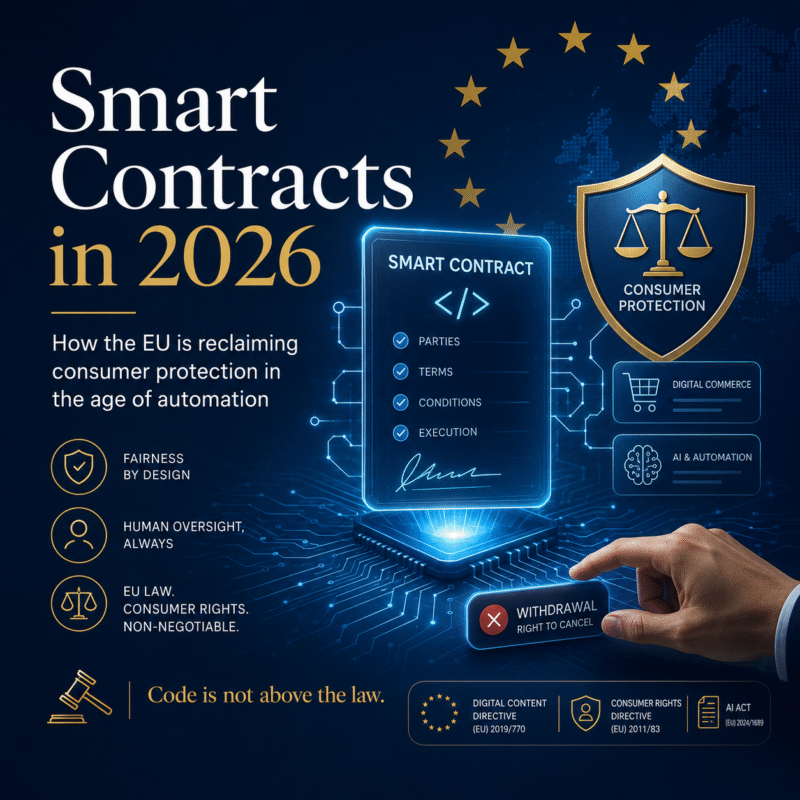
In the European Union, the year 2026 marks a decisive and historic turning point for consumer protection in digital commerce era. As smart contracts are self-executing, immutable and non-justiciable code that automatically triggers transactions. The goal was not to replace or displace traditional contracts, but rather to streamline certain aspects of contracting plus increase efficiency of parties’ promises. These blockchain-based agreement move from niche crypto-experiments to mainstream tools for purchase daily stuff, insurance, energy trading, and subscriptions, the EU has introduced a formidable wall of legislation.
By the end of 2026, the guiding principle of European digital commerce is no longer “Code is Law,” but rather “Law is the Code’s Boundary.”
The Paradox of Automation and Consumer Choice
Smart contracts are celebrated for their automaticity and immutability. For a consumer, this can mean an instant flight delay payout without filing paperwork. However, these same features create a “black box” that can trap users in unfair terms or execute transactions without a human’s ability to intervene.
To address this, the EU has deployed a multi-layered regulatory framework .A core ideological commitment of this contractual renaissance is to empower individuals to bargain on a peer-to-peer basis, without so-called “trusted third parties” whether commercial intermediaries (such as banks and marketplace-hosts) or public authorities (such as courts). This strategy ensures that while the technology remains fast, the legal protections remain robust.
1. The Right to Terminate: Breaking the “Immutable” Chain
A cornerstone of the 2026 landscape is the EU Data Act. As of September 12, 2026, the “data access by design” obligations come into full force. Crucially for smart contracts, the Act mandates that automated agreements must be designed with the capability for safe termination and interruption.
In practice, this means smart contracts are no longer allowed to be truly “unstoppable” if they involve a consumer. Developers must build in “kill switches” or pause mechanisms that allow a consumer or a court to halt the execution of the contract in cases of fraud, error, or the exercise of statutory rights. (read Article 36 of EU Data Act about the smart contracts requirements at the bottom of this paper).
2. The Mandatory “Withdrawal Button”
Under the updated Consumer Rights Directive, by June 19, 2026, all online platforms operating in the EU must feature a standardized “Withdrawal Button.” This is a direct response to “subscription traps” and automated smart contract renewals.
If a consumer enters into a smart contract-based subscription, the law requires that cancelling that contract must be as easy as starting it. The “Withdrawal Button” must be clearly visible and permanently accessible, ensuring the backend automation does not become a barrier to the 14-day right of withdrawal (Article 11a CRD)
3. Liability for Code: Software as a Product
One of the most significant shifts for consumer protection is the Product Liability Directive (PLD) overhaul, which Member States must implement by December 9, 2026. For the first time, the definition of a “product” explicitly includes software and AI.
This change removes the legal ambiguity surrounding “bugs.” If a flaw in a smart contract’s code leads to a loss of personal data or financial harm, the consumer no longer has to prove the developer was “negligent.” Instead, a regime of strict liability applies. If the code was defective and caused harm, the provider is liable full stop (Article 4 PLD).
4. Transparency and the AI Act
Many modern smart contracts are increasingly “smart” they use AI models to determine outcomes, such as adjusting a loan’s interest rate in real-time. Under the EU AI Act, which sees its major compliance deadline on August 2, 2026, these systems are often classified as “high-risk.” The Act requires that consumers be notified when they are interacting with an AI-driven contract. Furthermore, providers must ensure human oversight, meaning a human must be “in the loop” to review and potentially override an automated decision that negatively affects a consumer’s rights. Fairness by Design and the Digital Fairness Act to wrap these protections into a cohesive whole, the European Commission is advancing the Digital Fairness Act (DFA), with major proposals expected in the final quarter of 2026. The DFA aims to ban “dark patterns” manipulative interface designs that nudge consumers into signing smart contracts they don’t fully understand. By enforcing “Fairness by Design,” the EU requires that the very user interface (UI) through which a smart contract is signed must be neutral and transparent
Conclusion
As we move through 2026, the EU has made its stance clear: technology will not be an excuse to bypass consumer rights. Smart contracts offer immense potential for efficiency, but they must now operate within a legal framework that prioritizes human agency. For the European consumer, the “digital era” no longer means being subject to the whims of immutable code, but rather enjoying the speed of automation with the safety net of the law.
SOURCES:
- https://eur-lex.europa.eu/eli/reg/2023/2854,
- https://commission.europa.eu/law/law-topic/consumer-protection-law/consumer-contract-law/consumer-rights-directive_en
- https://eur-lex.europa.eu/legal-content/EN/TXT/?uri=OJ:L_202402853
- Ana Mercedes Lopez Rodriguez, 20/October/ 2025, Consumer protection in blockchain-based metaverses: a comparative study of cross-border legal gaps and platform governance, Frontiers, www.frontiersin.org/journals/blockchain/articles/10.3389/fbloc.2025.1675735/full
- Aaron Krowne, 14/November/2024, Legal Challenges in Defining and Regulating Smart Contracts, IBL LLP, https://ibl.law/legal-challenges-in-defining-and-regulating-smart-contracts/
- Alexandros A. Papantoniou, 04/November/2020, Smart Contracts in the New Era of Contract Law, Digital Law Journal, https://www.digitallawjournal.org/jour
Article 36 of EU Data Act:
Essential requirements regarding smart contracts for executing data sharing agreements
1. The vendor of an application using smart contracts or, in the absence thereof, the person whose trade, business or profession involves the deployment of smart contracts for others in the context of executing an agreement or part of it, to make data available shall ensure that those smart contracts comply with the following essential requirements of:
| (a) | robustness and access control, to ensure that the smart contract has been designed to offer access control mechanisms and a very high degree of robustness to avoid functional errors and to withstand manipulation by third parties; |
| (b) | safe termination and interruption, to ensure that a mechanism exists to terminate the continued execution of transactions and that the smart contract includes internal functions which can reset or instruct the contract to stop or interrupt the operation, in particular to avoid future accidental executions; |
| (c) | data archiving and continuity, to ensure, in circumstances in which a smart contract must be terminated or deactivated, there is a possibility to archive the transactional data, smart contract logic and code in order to keep the record of operations performed on the data in the past (auditability); |
| (d) | access control, to ensure that a smart contract is protected through rigorous access control mechanisms at the governance and smart contract layers; and |
| (e) | consistency, to ensure consistency with the terms of the data sharing agreement that the smart contract executes. |
2. The vendor of a smart contract or, in the absence thereof, the person whose trade, business or profession involves the deployment of smart contracts for others in the context of executing an agreement or part of it, to make data available shall perform a conformity assessment with a view to fulfilling the essential requirements laid down in paragraph 1 and, on the fulfilment of those requirements, issue an EU declaration of conformity.
3. By drawing up the EU declaration of conformity, the vendor of an application using smart contracts or, in the absence thereof, the person whose trade, business or profession involves the deployment of smart contracts for others in the context of executing an agreement or part of it, to make data available shall be responsible for compliance with the essential requirements laid down in paragraph 1.
4. A smart contract that meets the harmonised standards or the relevant parts thereof, the references of which are published in the Official Journal of the European Union, shall be presumed to be in conformity with the essential requirements laid down in paragraph 1 to the extent that those requirements are covered by such harmonised standards or parts thereof.
5. The Commission shall, pursuant to Article 10 of Regulation (EU) No 1025/2012, request one or more European standardisation organisations to draft harmonised standards that satisfy the essential requirements laid down in paragraph 1 of this Article.
6. The Commission may, by means of implementing acts, adopt common specifications covering any or all of the essential requirements laid down in paragraph 1 where the following conditions have been fulfilled:
| (a) | the Commission has requested, pursuant to Article 10(1) of Regulation (EU) No 1025/2012, one or more European standardisation organisations to draft a harmonised standard that satisfies the essential requirements laid down in paragraph 1 of this Article and:(i)the request has not been accepted;(ii)the harmonised standards addressing that request are not delivered within the deadline set in accordance with Article 10(1) of Regulation (EU) No 1025/2012; or(iii)the harmonised standards do not comply with the request; and |
| (b) | no reference to harmonised standards covering the relevant essential requirements laid down in paragraph 1 of this Article is published in the Official Journal of the European Union in accordance with Regulation (EU) No 1025/2012 and no such reference is expected to be published within a reasonable period. |
Those implementing acts shall be adopted in accordance with the examination procedure referred to in Article 46(2).
7. Before preparing a draft implementing act referred to in paragraph 6 of this Article, the Commission shall inform the committee referred to in Article 22 of Regulation (EU) No 1025/2012 that it considers that the conditions in paragraph 6 of this Article have been fulfilled.
8. When preparing the draft implementing act referred to in paragraph 6, the Commission shall take into account the advice of the EDIB and views of other relevant bodies or expert groups and shall duly consult all relevant stakeholders.
9. The vendor of a smart contract or, in the absence thereof, the person whose trade, business or profession involves the deployment of smart contracts for others in the context of executing an agreement or part of it, to make data available that meet the common specifications established by implementing acts referred to in paragraph 6 or parts thereof shall be presumed to be in conformity with the essential requirements laid down in paragraph 1 to the extent that those requirements are covered by such common specifications or parts thereof.
10. Where a harmonised standard is adopted by a European standardisation organisation and proposed to the Commission for the purpose of publishing its reference in the Official Journal of the European Union, the Commission shall assess the harmonised standard in accordance with Regulation (EU) No 1025/2012. Where the reference of a harmonised standard is published in the Official Journal of the European Union, the Commission shall repeal the implementing acts referred to in paragraph 6 of this Article, or parts thereof which cover the same essential requirements as those covered by that harmonised standard.
11. When a Member State considers that a common specification does not entirely satisfy the essential requirements laid down in paragraph 1, it shall inform the Commission thereof by submitting a detailed explanation. The Commission shall assess that detailed explanation and may, if appropriate, amend the implementing act establishing the common specification in question.